Indigeneity in dance pedagogy and performance
[Theme music fades in behind the narration]
[00:00:00] Ojeya Cruz Banks: when we talk about indigenous dance, we don't call it indigenous dance. I don't know why, 'cause it really is, but the way in which we have recovered that culture, is phenomenal. And that is a brilliant example of grassroots dance education that people of African diaspora heritage have created for themselves.
[Theme music plays at full volume]
[Theme music fades out]
[00:00:32] OreOluwa: Welcome to Groovin’ Griot, a podcast about how we use dance to tell stories. I'm OreOluwa Badaki.
[00:00:38] Azsaneé: And I'm Azsaneé Truss. Let's get grooving.
[00:00:54] OreOluwa: Okay, here we are [00:01:00] moving into the Native North America Gallery.[00:01:04] Passing by, some really studious looking young people who are here on a field trip, uh, from the local elementary school. Hi! [00:01:19] Excellent. We're gonna join them in their inquiry. Hello there.
[00:01:26]Azsaneé: We are out in the field again, so to speak on today's
[00:01:29] OreOluwa: That's right. We're coming at you from the Penn Museum, which is kind of your stomping ground, isn't it Azsaneé?
[00:01:35]Azsaneé: more or less, yeah. And what colonial grounds they are. Uh, no, but obviously I love being a postdoc in the Center for Experimental ethnography. And we're housed in the anthropology department, which means our lab space is in the museum. [00:01:48] And the folks I'm able to collaborate with and think with and make with in this space are explicitly focused on decoloniality. So it makes it a bit easier to reckon with, you know, all of this, [00:02:00] but I'm finding more breathing room for my work in ethnography as a method.
[00:02:03] OreOluwa: We've talked a bit about the connections between ethnography and dance research already on the show. Our conversation with Margitt Edwards was particularly helpful on that front. So today we're diving deeper into this topic and exploring how ethnographic research of dance can take us behind the scenes [00:02:19] of how cultures are made, preserved and transformed.
[00:02:22]Azsaneé: That's right. Today's guest is Dr. Ojeya Cruz Banks. [00:02:25]She's a professor of dance at Denison University who focuses on dances of the African diaspora and indigenous Pacific.
[00:02:31] OreOluwa: True to her focus on indigeneity and ancestry, [00:02:34] at the outset of the interview, Dr. Cruz Banks took us back to the roots of the term “Griot”.
Introduction
[00:02:40] Ojeya Cruz Banks: I think that it's important to remember the significance of Griots, right in West Africa and also across the diaspora. It's about keeping track of the family stories. And so let me tell you a little bit about my family. My mothers of many [00:03:00] generation are from the island of Guåhan, and n is located in the Northwestern Pacific Ocean.
[00:03:07] Um, it's an Archipelago of many islands, but Guåhan is the southern, the most southern island that's close to the deepest valley of the ocean floor. And then we Black folk on my father's side, we're from Alabama, Kentucky, I also have some Louisiana roots. Um, my family raised me in the church, the Black church, where, um, my grandmother's two generations back have played the piano for the church, that, that our families have gone to.
[00:03:50] Um, which is, I think, one of the quintessential expressions of Griot-ness in Black [00:04:00] America. And there was a point in my journey as an artist, as a scholar, where I got very clear that I needed my work to keep me anchored in the search of who I am and to reclaim the stories, the wisdom, the knowledge of my people,
[00:04:31] um, and what I've kind of come to, especially after achieving a lot of academic accolades, um, and building a career as a dancer anthropologist, is that, that my truest university is really, within the institution of my, of my family story, my [00:05:00] genealogy.
[00:05:01]Azsaneé: I love the point that Dr. Cruz Banks makes about the truest university being within one's own family genealogy. We're walking through the Native North American exhibit right now at the Penn Museum. And university museums like this one, and museums more broadly have had complicated and tenuous relationships with the quote unquote cultural heritage.
[00:05:19]: they often put on display. They frequently interrupted, halted, and suppressed the family genealogies that Dr. Cruz Banks talks about.
[00:05:26] OreOluwa: Yeah, I'm noticing here, we are standing at the exhibit that is focusing on the Lenni-Lenape who are indigenous to the land we are standing on right now here in Philadelphia.
[00:05:39] Something that is striking is this point of “surviving, rupture, removal and change”. We're looking at some of the artifacts that Lenape ancestors have loaned the museum, and a question that we've been thinking about is, you know, what happens when
[00:05:53] these artifacts are moved from these places that they came from. And what, uh, sort of [00:06:00] curatorial practices, um, indigenous folks, indigenous cultures might have already been using, right?, before coming to this kind of institutional space.
[00:06:08] Um, and. Along the lines of rupture and repair, like where their, where that story, where their stories can still be preserved.
[00:06:18] Azsaneé: Fortunately, the artifacts that keep these genealogies alive can also go beyond, you know, the objects that we're seeing in this exhibit here for example. Um, Dr. Cruz Banks discussed how dance is one way that these genealogies live on.
Early dance experiences
[00:06:31] Ojeya Cruz Banks: I began dancing with my family. And my grandmother would always, you know, pull the family up after we would have a fiesta and, and everybody would dance. Everybody; grandma, grandpa, aunties, uncles, and everybody would do the chacha.
[00:06:49] And it didn't matter which song was on, like we weren't listening to like, Cuban Chacha music, you know, it was anything, you know, that had a beat where we could [00:07:00] put that triplet in. Those were the fondest memories of my childhood. Um, and I think that I have kind of spent a lot of my adult life chasing the euphoria of that.
[00:07:19] Chasing the, the healing, experience of dancing with my family, activating the energy of joy, activating the energy of connection between us.
[00:07:35] This experience of dancing with my family has just, you know, it really stuck with me and I didn't actually do much dance training until I was in my early twenties. Like my first dance class, I think I was 20. You know, and that was in Tucson, Arizona. And I worked with a woman by the name of [00:08:00] Barbea Williams, who's a Dunham certified dance teacher and was teaching West African dance, from Guinea.
[00:08:10] And she also did a little bit of Afro-Brazilian. And then I also met someone by the name of Eno Washington, Denise Bey, these are all African American, um, artists who found African diasporic dance and brought it to their communities. And it was like, I found my church. I was like, this is, this is it. You know?
[00:08:43] It's like, as long as I keep close to this world. You know, I'm gonna have that ancestral currency that we were just talking about.
[00:08:54] OreOluwa: Alright. So we were able to find a quieter room to continue some of this [00:09:00] conversation.
[00:09:00] Azsaneé: Yes. We may or may not be trespassing.
[00:09:01] OreOluwa: We may or may not be trespassing. And if that's the case, it's okay. We go here?,
[00:09:06] Azsaneé: Well you don't…
[00:09:07] OreOluwa: …anymore. Anymore. But I have an alumni id, so.[00:09:11] Come at me. No, don't. Please don't.[00:09:13] Azsaneé, do you remember how the concept of ancestral currency came into play during our conversation?
[00:09:19] Azsaneé: Yeah, it was something that Dr. Cruz Banks thought I said, which I will fully revise the record to say that I did. Um, and it kind of just stuck throughout the conversation.
[00:09:28] OreOluwa: It did. And I, and I don't think that's by accident. [00:09:31] I've done a couple performances here at the Penn Museum, and each time it's another reminder of how integral it is to pay heed to those who came before us. Dr. Cruz Banks talked about how staying close to this world of African diasporic dance led her to the work of seminal forebearers in dance, ethnography, and anthropology.
Ethnography and dance
[00:09:49] Ojeya Cruz Banks: I ended up hearing about a Catherine Dunham dance seminar in St. Louis. Like, I think I went to the last one [00:10:00] that she was present for. [00:10:02] And going to the Dunham seminar was a revelation because I, um, you know, was able to kind of like witness. This pedagogy that was created by Katherine Dunham that was drawing from multiple lineages of Black folk, you know, across the Americas, but also, you know, borrowing from Western approaches to dance such as ballet and, and contemporary, and I just loved it.
[00:10:44] And so I think that the ethnographer in me has polished my articulation of dance so that I can think about dance in really global ways that don't [00:11:00] get, I don't wanna be univer, I don't wanna think about dance in these kind of like, universal ways that don't, you know, take us into like the nuances.
[00:11:10] So for example. When I lived in New Zealand, I had the opportunity to study, um, and to engage in a research project that was coordinated by the Atimira Dance Company. And this is, um, a leading contemporary dance company in New Zealand. It was founded in 2011 by Maori artists and, um, and they were looking at some of the like ancestral stories of early haka and they were working with a, an incredible, scholar artist, , Dr.[00:11:52] Charles Royal who did research on the whare tapere, which is literally means like the, [00:12:00] literally means performing arts in Maori and, and found that one of the original words for dance is *fakawa* and *fakawa* means to become. And it's about letting the energy or the creative expression of the earth, of the natural world, to come through you[00:12:29] And so[00:12:34] that blew my mind. I was like, wow, what a definition of dance. Right?
[00:12:39] OreOluwa: This notion of dance as a physical manifestation of energy opens up a lot of possibilities for how to understand not just movement, but ancestry as well.
Dance and indigeneity: the word for dance…
[00:12:48] Ojeya Cruz Banks: Um, and then on my own island, , when I first started traveling to Guan, I found that,[00:12:56] the word for dance is complicated [00:13:00] because, when people think of the performing arts, it's, it really starts from chant. Right. So choreographies come from wanting to embody the story that's embedded in the chant itself.
[00:13:18] And then we know, for example, you know, in Wolof land, right? Sabar means dance, music, gathering. Um, and it's,the terminologies are, get tricky when you, when you start looking outside of Western contexts. And so if I was to use the word dance education in um, Aotearoa or in Guåhan or even in Sabar, I might not get any, like, interests 'cause they like, what is that?
[00:13:54] Um, so you have to actually get acquainted with [00:14:00] the , Indigenous concepts of the land that you're on so that you can really understand what dance is and why we dance and why it's important for the social, emotional, psychological development, um, of us as human beings. I mean the, the physical strength is just like, you know, the bonus.
[00:14:26] Um. I studied Yamama with Moustapha Bangoura, who danced with the National Ballet of, of Guinea, um, for many, many years. And I've written a lot about my experiences of dancing at, um, le Bagatae, which is his school in Guinea. And I learned a song from him, that recites the name of a legendary Yamama dancer.
[00:14:55] Just knowing that I was singing the dancer's name [00:15:00], *Mimbo*, um, had gravity to me. I think that there's something about the way in which the, these rhythms evoke memory [00:15:12] I mean, if you think about like, some of these rhythms go back 13th century, you know, so it's like you and I are dancing to these rhythms that our people of many, many generations have danced. [00:15:27] And so actually I think that when we talk about indigenous dance, we don't call it indigenous dance. I don't know why, 'cause it really is, but the way in which we have recovered that culture, is phenomenal. And that is a brilliant example of, [00:15:47] grassroots[00:15:49] dance education that people of African diaspora heritage have created for themselves.
[00:15:56] Azsaneé: I think that's really powerful, acknowledging African diasporic [00:16:00] dances as indigenous dances and seeing how that has opened connections to other indigenous cultures around the world. And on that note, what do you say we pause for a movement break?
Movement Break
[00:16:07] OreOluwa: I think that sounds like a plan. So Dr. Cruz Banks is also a singer and incorporates vocal work in her choreography and performance. During the interview, she graced us with part of a song from a recent performance piece.
[00:16:21] Ojeya Cruz Banks: I need to learn
[00:16:31] how to navigate.
[00:16:40] Read the Star
[00:16:46] and the wind.[00:17:00]
[00:17:01] Like she did,
[00:17:11] like she.
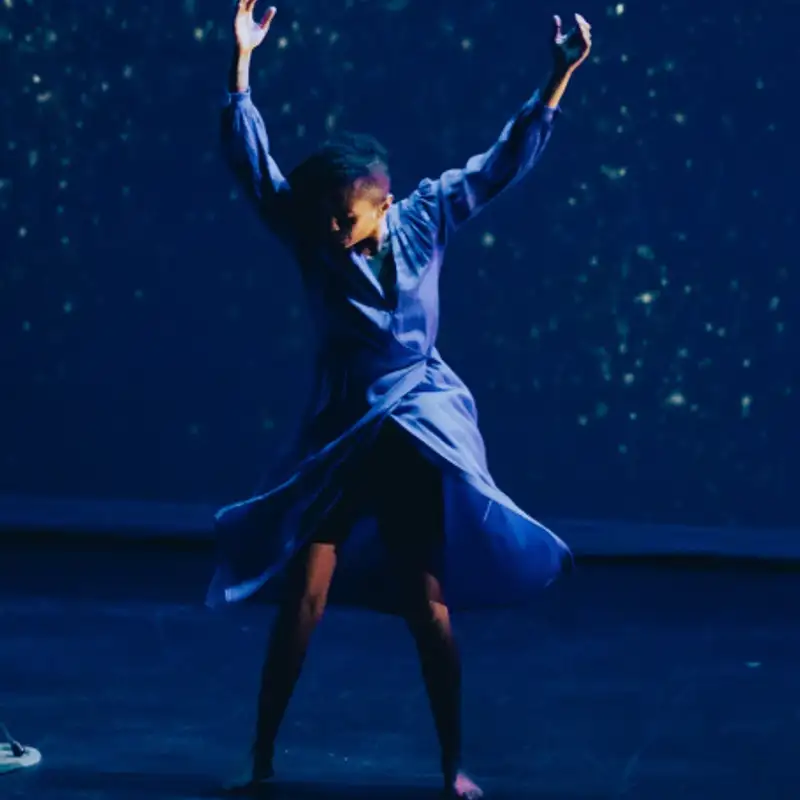
[00:17:18] Azsaneé: Welcome back. The recent performance is titled Mareas, Dr. Cruz Banks co-curated it with her colleague Marion Ramirez from Puerto Rico. She told us a bit about the process behind the piece.
[00:17:29] Ojeya Cruz Banks: We're just kind of taking in like the connections between our islands 'cause they're both dealing with territorial politics of the US military. And we both, you know, identify, , with our island strongly and
[00:17:45] wanted to do work that was, you know, that could kind of help us distill some of those connections. And the work that I brought to Mareas was reall, a creative process that, that had [00:18:00] already been in motion. So I had been working on a piece that, like, at the time was called Dancing the Black Atlantic and the Blue Pacific.
[00:18:09] And it was, a, a piece that was,, in memory of a very dear friend of mine who passed away in 2017 by the name of Teresia Teaiwa, who's a well-known Pacific Studies, um, scholar, and poet. And she was a Black Pacific scholar as well. So her mother is African American from DC, father was from Kiribati, grew up in Fiji, also lived sometime in Hawaii and in Guåhan.
[00:18:46] And she brought together a cohort of us who were of indigenous Pacific heritage as well as African diaspora heritage. And that really set me on a [00:19:00] particular path because before that I had been kind of compartmentalizing a lot of my, my research and, and I don't think I did it on purpose. It was, like, I just hadn't seen the connections yet, you know?
[00:19:12] And so I started to kind of look at, well, what are the relationships? You know, and, and obviously, uh, um, one was just like my story, you know, like my lineage is the story of, of the Black Pacific and the Black Pacific is a, a very complex term. , 'Cause you know, some people might think right away of Melanesia, right?
[00:19:41] Places like Vanuatu and Fiji. My research, because I am of African American descent, is really looking at the ancestral connections between the Pacific and, and the African diasporic world, but also the way [00:20:00] in which African diasporic, culture fertilizes or contributes to the evolution of indigenous Pacific dance.
[00:20:11] Just think about how global Black culture is and how, you know, consumed it is, and reappropriated, and, you know, and the way in which it inspires. And it's problematic too, right? Because it's like, it's just all over the world and nobody knows much about its lineage.
[00:20:31] And, and then credit isn't served. So I think that the piece that I've been doing is really about trying to, to create some historical, reparations of that because I think I'm well placed to do that 'cause I have, you know, the ancestral support to do that work.
[00:20:52] Azsaneé: Seems like we're getting back to this notion of ancestral currency.
[00:20:55] OreOluwa: Exactly, and I think it gets even more interesting when we consider that the [00:21:00] meaning of the Latin root of the word “currency” is something like “that which flows, that which is in circulation”. So some of the work Dr. Cruz Banks is actually doing here can be understood to be about bringing back into flow, into circulation, the ancestral and indigenous practices that orient and stabilize us.
[00:21:19] Azsaneé: Right. And she talks specifically about how alter making as both an everyday practice as well as a performance practice helps us to do just that.
Altar making as part of performance and practice
[00:21:27] Ojeya Cruz Banks: One of the things that I do to prepare is, it starts with an, with, um, alter. I make an altar and on that altar, I always use this fabric that was stitched.
[00:21:42] It's a, a patchwork lapa from Guinea and it's, it was part of the altar that I created with Teresia, when she was still with us on this side. And on that [00:22:00] altar, I have sacred coconut oil from my island of Guåhan. I have cowrie shells that have been gifted to me by the ocean from Guåhan, from Aotearoa, from Brazil, from Barbados.
[00:22:16] And, other things like, vessels for, pouring libation. I have pictures of my, my ancestors and my elders and so there's a lot of spiritual preparation like that I have to get myself psychologically, spiritually. In the frequency of, of who I am and the cultural ways of,
[00:22:44] of dancing in a grou, you know, anchored in that ancestry. And so the, the altar provides the beginning practice of just like, okay, let me slow down. 'Cause normally, you know, before [00:23:00] we perform, we're kind of running around trying to get everything together. And , but, that is a, alter making is a very significant spiritual practice for CHamoru people.
[00:23:10] Um, and, it's not, we don't do it for just performance. We, it's, if you came to my house, like what you see behind me is an altar. So it's, it's something that's really important for , honoring the space, honoring the land, introducing myself to the land that I'm on before I perform.
[00:23:31] I'm a singer as well as a dancer, and so I often, um, will sing to kind of prepare my body, um, for dance. And that was something that I learned from my people inGuåhan, right to chant is to dance, that there's a resonance. There's a resonance that you get in the body that prepares the organs, prepares the vagus nerve, regulates the nervous system, right?
[00:23:58] So that you can [00:24:00] catch the spirit and the, you know, and the spirit can speak through you. So per, you know, the performance preparation, I think is very much grounded in, um, that ancestral, those ancestral practices. And, and they're right on stage with me, you know, so it's, it's nice to have that support, and whenever I get, I have like nervous energy or I'm feeling, overwhelmed
[00:24:34] you know, it's nice to like, oh yeah, there's this part of the dance, or at any point I can go over there and like, grab the sacred coconut oil, you know, and anoint myself and like, take a moment. Like, that's the, that's it, that's the performance, you know? Um, that transcends kind of those boundaries that we can
[00:24:56] create between the audience and the performance and [00:25:00] the preparation rituals that are very important to who we are as artists.
[00:25:06] Azsaneé: We could have continued this conversation about movement and spirituality and indigeneity for hours. Um, but of course we had to stop somewhere. So as always, we closed out our conversation with Dr. Cruz Banks by asking her what she's grooving to these days.
[00:25:19] Ojeya Cruz Banks: a song that I've been listening to a lot by the Trio Da Kali, that's called Tita, that's really beautiful and it's got like the kora in it. I also listen to a lot of music by Dakota Camacho, who's a CHamoru MC, language revitalization, activist.And then I have a real soft spot for, British Soul music. [00:25:47] Black British music, so I'm into FACESOUL and also Sault.
[00:25:55] Azsaneé: Yeah. It took me way too long to realize that Cleo Sol was the front woman, so I [00:26:00] was listening to them both.
[00:26:01] Ojeya Cruz Banks: I did not know that.
[00:26:02] Azsaneé: Yeah, yeah, yeah. Cleo Sol's the front woman of Sault.
[Theme music fades in for credits]
[Music plays]
[Music is lowered behind the credits]
[00:26:13] OreOluwa: This episode of Groovin’ Griot was produced and edited by me, OreOluwa Badaki and my co-host, Azsaneé:Truss.[00:26:20] Our theme music is Unrest by ELPHNT and can be found on directory.audio.
[00:26:25] Azsaneé: You can follow us at Groovin’ Griot and email us at groovingriot@gmail.com. Groovin’ Griot is part of the network of podcasts supported by the Digital Futures Institute at Teachers College Columbia University, for another great show from the DFI network, [00:26:38] check out the Curriculum Encounters podcast, which is about exploring knowledge wherever you find it.
[00:26:43] OreOluwa: Co-host Dr. Jackie Simmons and Dr. Sarah Gerth van den Berg [00:26:46] invite listeners alongside as they explore different spaces and consider how curriculum is a social, spatial and embodied process. It's a great sensory experience, so take a listen. We'll link to it in our show notes.
[00:26:58] Azsaneé: That's all for now. [00:27:00] Thanks for grooving with us.
[Theme Music fades out]
*BLOOPERS*