Echoes that orient us
[Theme music fades in behind the narration]
[00:00:00] Tsitsi Jaji: So I guess it was accidental, but also very much about a principle I was committed to - which is that one figures out who one is in relation to others through difference and through the slightest of delays.
[00:00:27] OreOluwa: Welcome to Groovin’ Griot, a podcast about how we use dance to tell stories. I’m OreOluwa Badaki.
[00:00:32] Azsaneé: and I'm Azsaneé Truss. Let's get grooving.
[Theme music plays at full volume]
[Theme music fades out as we transition to sounds of flipping through pages]
[00:00:57] OreOluwa:Us turning some [00:01:00] pages.
[00:01:00] Ms. Yvonne: Back here.
[00:01:01] OreOluwa: Oh.
[00:01:01] Ms. Yvonne: Poetry books over here.
[00:01:03] OreOluwa: Oh.
[00:01:03] Ms. Yvonne: And then books by, uh, uh, like Bell Hooks and, and Nikki Giovanni. They're up in the front. Okay. Thank you.
[00:01:12] OreOluwa: You said poetry books are over here?
[00:01:13] Ms. Yvonne: Say it again?
[00:01:14] OreOluwa: Poetry books are over here.?
Ms. Yvonne: Yeah, right here.
OreOluwa: Thank you so much.
Ms. Yvonne: Mm-hmm.
Introduction
[00:01:18] Azsaneé: We've really been enjoying narrating the podcast from the field. So today we're in West Philly at a place that's a true staple for the community. Hakim's Bookstore.
[00:01:26] Ms. Yvonne: Hi, my name is Yvonne Blake, and we are here at Hakim's Bookstore, located at 210 South 52nd Street in West Philadelphia.
We have the distinction of being the first and oldest African American bookstore opened in Philadelphia and on the East coast, and we were granted a historical marker in 2023. The store was started by my late Father Dawud Hakeem and we're still family owned and operated.
Okay. Thank you. Come back again. I will. I will be back. Alright. Thank you.
[00:01:54] OreOluwa: Oh, these are plays. I'm reading this right now, rereading August [00:02:00] Wilson's.
[00:02:00] Azsaneé: Oh I should… I went to see one of his plays.
[00:02:02] OreOluwa: Yeah.
[00:02:03] Azsaneé: At the Arden, last, two years ago.
[00:02:05] OreOluwa: Nice. Do you remember which one?
[00:02:10] Azsaneé: Uh Radio Golf. Mm-hmm.
[00:02:10] OreOluwa: Radio Golf. Yeah. Classic.
OreOluwa: Being here feels especially right for this episode as we're exploring the connections between African diasporic literature and movement. Our guest today is Professor Tsitsi Jaji, the Helen L Bevington Associate Professor of Modern Poetry at Duke University. Her work is deeply rooted in literature and how it intersects with sound, and of course, movement.
[00:02:33] Azsaneé: And so hanging out at Hakim's as we reflect on this interview with Professor Jaji is very apt. She started out by telling us about her very early introduction to the ways that sound, language, and movement carry history.
Early beginnings: connecting dance, music, and poetry
[00:02:47] Tsitsi Jaji: So the way I think about this is that I came into language, movement and sound in the same moment. I was born in Zimbabwe in a [00:03:00] rural area on a mission station in a part of the country where if you needed to have a C-section, it was probably too late for you or your mother to survive. Um, I survived and so did my mother and my grandmother was so grateful that she was dancing and singing Amazing Grace in Shona.
And the first line of that is um Tsitsi dzinondishamisa Um and so that's how I got my name. It, it means grace and, my creative practice begins there, uh, with poetry, which is what a hymn is. Um, with the, frictions between languages and places. Amazing Grace was written by a enslaver, um, and movement as, uh, a expression of relation.
I studied ballet from the [00:04:00] time I was five to, honestly, in my thirties, but mostly until I was, uh, 17, I was very serious, and it was in the ballet company in Zimbabwe and blah, blah, blah. Um, it didn't stay with me, but I think the coordinating of movement and sound did. And my sense of meter in my poetry of rhythm and timing, where you fall, where you lift, all that sort of thing.
It really does. Stay connected to dance.
[00:04:35] OreOluwa: Being born into song movement and language all at once had a lasting effect on how Professor Jaji approached her scholarship. Her work unpacks the ways that song and dance inform African and African American literary and cultural studies focusing on the ways that poetry, movement, and sound are connected practices of making meaning.
Music as interpretive tool for poetry
[00:04:53] Tsitsi Jaji: My other research and writing right now is a book on classical music by black [00:05:00] composers. And, um, the way that song, uh, is a really important interpretive tool of poetry.
So I sing, I take lessons, I learn the repertoire I'm writing about, I play piano, et cetera, et cetera. Is it contributing to my scholarship? I don't know. I think it is, I think I have a better organic insight into things like how breath matters, um, how the body's involved in this work of interpretation.
That's very different from if you're just typing things and it makes me happy.
[00:05:39] Azsaneé: What I really love about that is the idea that scholarship isn't just something that happens on the page - that instead it lives in the breath, in the body, and how you shape a phrase. Professor Jaji even draws parallels between the creative discipline required to write and how we train as dancers.
Creativity of discipline/ Discipline of creativity
[00:05:53] Tsitsi Jaji: Um, it's interesting 'cause I'm actually currently writing a short book, a long [00:06:00] essay about discipline and literature. Um, and in many ways I think people feel as though, or assume that the push, um, to integrate creativity or at least to integrate all aspects of ourselves into scholarship looks like undisciplined work and sometimes we even are interested in that, um, as an intellectual and political project, right? The un-disciplining of what we do. Um, but I actually feel very strongly that disciplinary grounding is essential. And I'm sure as dancers, you know, you train your body, you build muscles, you learn the relationship between space and sound and all those kind of things.
[00:06:51] OreOluwa: The idea of creative discipline really resonates. There's this myth that creativity means freedom from structure somehow, but in dance and in other [00:07:00] modalities, it's often the opposite. We often refer to working in various creative forms as having a practice, which implies rigor and consistently dedicating yourself to a craft.
[00:07:11] Azsaneé: Right, which all require,well, discipline.
This is something Dr. Leila Aisha Jones talked a bit about last season, the discipline necessary to practice African diasporic dances. Professor Jaji expands on this by making connections between the disciplines of dance, music, and writing.
Multimodality of writing
[00:07:26] Tsitsi Jaji: I'm working on a series of dance poems, actually. Um, it'll take a while, but in that I'm actually trying to, it's not a memoir, but it's a situated history, I would say. Thinking about Zimbabwean history and diaspora and my American relatives and mothers uh, white Ohioan, um, she's recently joined the ancestors. But, um, this is all to say, I think you can tell a story through [00:08:00] movement in poetry, but it requires research. Um, how poetry informs my scholarly work. Number one, I craft sentences very carefully. I juxtapose them very carefully. It can make writing, academic work,very slow.
Um, I often plan an essay by drawing it, you know, like an outline, but it has to be a handwritten outline and that's how I write my poems as well. Um, and I do sometimes let the lyrical in and the personal in to something that's still pretty traditionally scholarly. So like in my first book, which I'm so delighted you're still reading 10 years after it came out, um, [00:09:00] you know, it opens with a reflection about, uh, the first diasporic music I remember, which was, um, Bob Marley's, uh, Buffalo Soldier. And it closes with this very lyrical section, um, singing stones, and those were not in my dissertation, I don't think my beloved dissertation committee would have encouraged that. And I often say that to grad students as well. You'll get there. This is just, you know, this is your ticket in the door and then you can dance on the other side of it.
But that's a metaphor for me. It's a reality for you guys as dance scholars.
[00:09:37] OreOluwa: That metaphor of the dissertation as a doorway you pass through before you really get to dance feels so real. I came across the book, professor Jaji just referenced towards the end of my dissertation and I was like, “Wait, what? You can do this in academia?”
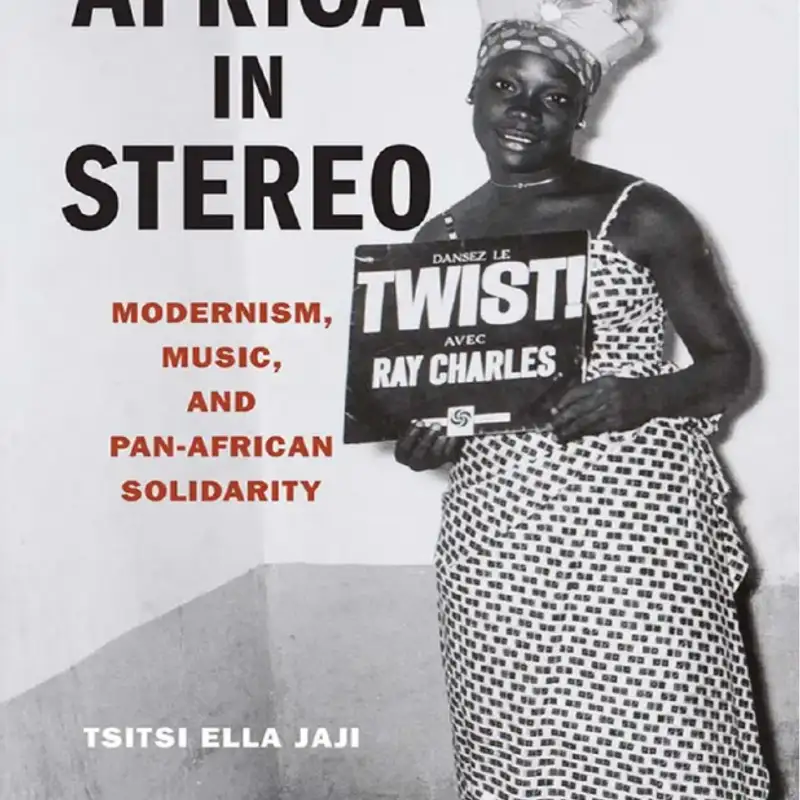
[00:09:53] OreOluwa: I remember it gave me a lot of hope and confidence in taking dance, research and practice seriously in a field that wasn't [00:10:00] necessarily designed for it. The book Professor Jaji referenced is called African and Stereo: Music, Modernism, and Pan-African Solidarity.
[00:10:07] Azsaneé: She shared a bit about how her music practice and how other creative and multimodal scholars informed the ideas behind her book.
Music as entry point to Stereomodernism
[00:10:13] Tsitsi Jaji: This thing about music was important to my learning, how to locate myself in a US blackness. And I, I mentioned it in my book in terms of being asked to come play for Black church. And there are the same kinds of, um, segregations in the US, in the Zimbabwean church in that, when I was growing up, most churches were either predominantly white or predominantly black.
But for some reason it bothers me more in the US I think maybe because it doesn't align with, um, language and, you know, because maybe a certain kind of church version [00:11:00] of spirituality just doesn't align with me. But anyways, long answer to say music was my way in. Um, and is my kind of first language in some ways, and, but I was in a literature program and like, at Cornell, very heavy literary theory. Derrida, I mean like when he died it's like the whole campus quiet.
I lived in a building that Fuko had lived in when he was like an exchange, uh, professor. So it's just to say it wasn't obvious per se, but I was very, very lucky that one of my committee member was, um, Jacques Coursil, a French Martinican, um, scholar. Brilliant, brilliant linguist who was there teaching [00:12:00] Francophone Caribbean literature, he was a close friend of Édouard Glissant.
And so my first class with him was on Glissant. Glissant, you know, this is a poet, a playwright, an essayist, et cetera. We, we don't read his poetry, we don't read his novels. He's very, very hard. But I do try. But anyways, the, the, the long and the short of it there is that Jacques was a serious jazz artist. Like he recorded in the sixties, he played with the Sun Ra’s orchestra and then he came back to performing and recording in his seventies, which was when he was my teacher.
And he was a very, very rigorous, uh, philosopher and um, also quite interested in psychoanalytic theory. So he was the model the ancient, you know, to fight against as the modern. Um, you know, he said to me one time, oh, [00:13:00] Africa's never been modern.
So you learn to argue and that is like an essential skill as a thinker to say no. And he would always say that you have to say no. So I did. Um, but he was an example of someone who didn't give up his music and it didn't interfere with his thought. It deepened it. But again, you know, here's this Caribbean, um, heritage French scholar teaching literature in upstate New York, et cetera, et cetera.
[00:13:35] Azsaneé: Professor Jaji learned from, as well as complicated, the work of those like Jacques Coursil and Édouard Glissant as she pursued her work. Like them, she didn't let go of her creative practice. She followed it and let it lead her to other art forms, to archives, and to countries across the African diaspora.
Following the music--behind the scenes of Africa in Stereo
[00:13:50] Tsitsi Jaji: And so I spent, um, like six months in Cape Town, around that much in, yeah, um, in Senegal. [00:14:00] And I wasn't sure what I was looking for. Mostly I was looking for coverage of jazz in poetry. And then it turned out also in, um, in magazines because that's where you could find information about music and um, those reviews and things like that.
And you see the pictures. And you see, oh, that's what they were dressing like in the sixties. You get distracted and then you realize, no, there's a discourse here. Um, and I had a, a student, a colleague, like who was also in my program who was doing popular culture and she was hip and all those things. And I always, I didn't really understand it, but then it turns out that's kind of what I was doing, looking at these magazines and, um, yeah. And so then I had all this stuff and I had to integrate it. And I will say, what I wrote about the magazines was the first thing I [00:15:00] wrote for my dissertation, and I liked it. And my advisor, Natalie Melas, um, was very pleased with it. Oh, you're making progress, et cetera. And then it just never fit in the dissertation. Like it just wasn't right for the argument that I was making. Also, the best chapter of my dissertation was my writing sample. I sent it out, it was my first publication on Kgositsile, the poet laureate of South Africa. It didn't make it into my book, you know, so something of the process of the book was coming up with an argument and, uh, the idea to pay attention to media formats, that only came out of meeting with an editor who was, you know, interested in the project. I won't name the press, but anyways, it was like, I would've been so excited about this media thing. I was like, oh yeah, it's kind of each, it's, it's, it's about multiple media. So I went and [00:16:00] I did the things that this person was implying that they'd be interested in, and that is not the press to publish my book. And we will just leave that there.
Yeah, but, but it's just to say you get guidance along the way. So sometimes people think you're deeply anchored in the archive, et cetera, et cetera, but no, it's like you had a picture of this one, this one and this one.
That's what you're gonna write about, because then it's like jazz. In jazz, you can't just play all the notes all the time. That's not free jazz. That's just me. Making noise, which is its own thing, right? Um, but if you have a limitation, if you have a certain chord progression or agreement of a gesture or whatever, and you guys know this from, from improvising in your own, uh, dance, you have to have some limits and then you can make things interesting.
[00:16:52] Azsaneé: I love that jazz metaphor. The idea that you can't play everything at once. You have to choose a structure, a set of limits, and then find freedom [00:17:00] inside of it. That feels true for choreography, for scholarship, and for life in general.
[00:17:04] OreOluwa: Agreed. And I think that's actually a great place to pause for our movement break.
[00:17:08] Azsaneé: That sounds good. Ore, can you tell us a little bit about what we're going to hear?
Movement Break
[00:17:11] OreOluwa: I can. So returning listeners may remember that we actually referenced Professor Jaji's work on the first episode of the season. We were talking about the influences behind the seed and sound performance.
In that episode, we referenced how she talks about the concept of echolocation in the diaspora. We'll get a chance to hear her talk specifically about that in a moment, so for this Movement Break, we're coming back to that concept of echolocation. This year I have the opportunity to be part of another piece that centers music and dance traditions from the African diaspora.
The piece is called Echoes of the Diaspora, aptly named, and it features a Philly based artist collective, brought together by Baba Kala Jojo. The piece centers how echoes can bridge past, present, and future timescales and create a sense of rooted resonance. The soundscape you're about to hear is from one of our rehearsals [00:18:00] and will hopefully get you ready to hear more about echolocation from Professor Jaji.
[00:18:04] [Sound collage from Echoes of the Diaspora rehearsal]
[00:20:22] Azsaneé: Welcome back. Hope that movement break helped you get in the right head, body, mind space to consider the role of echoes in the diaspora.
As promised, we're gonna get to hear from Professor Jaji about how she came to use echolocation as a way to understand diasporic experiences.
Echolocation: understanding connection through gaps/difference/limits
[00:20:37] Tsitsi Jaji: So, um, echolocation, I took a class in graduate school on electronic music. Um, like making, uh, electronic music.
And so we learned about, um, microphones. That's actually why I took it. I needed to know about microphones and so binaural and stereo and all that kind of thing was [00:21:00] coming up for me. But, there was a lot about echo in particularly, um, uh, Kwadwo Opoku-Agyemang’s poetry as a wonderful collection, Cape Coast Castle, which I was writing about.
And then, I don't know, it just occurred to me, this was an interesting image, echolocation. I think without realizing it, I'm always very, very intimately connected to the natural world and to animal being and partially I find it showing up in my creative work in that I write a lot of poems extending, um, the totem praise song tradition in Shona poetry.
And I think just being curious about that. And then the accident, which I think is always a wisdom, put ahead of you [00:22:00] that the exact meter for where something goes and then comes back in 17 meters or something like that. And, uh, that was a, the poem that I was looking at had 34 lines, something to that effect.
So I guess it was accidental, but also very much about a principle I was committed to, which is that one figures out who one is in relation to others through difference, and through the slightest of delays, because those are the spaces where one has to acknowledge and experience difference and not demand that any notion of solidarity implies unity, implies sameness, implies like suppressing ourselves. This is something that frustrates me a lot about [00:23:00] when people critique ideas of solidarity or, um, Pan-Africanism, et cetera. It's like, well, why should we be the same? The whole point is that we're not, and that there's gaps and that you get information from the gaps and from letting the gaps echo and then come back. And that, that to me, is that concept.
[00:23:24] OreOluwa: I find that idea that Professor Jaji describes about finding the gaps in between and letting that echo and, almost in a way, connect us even more rigorously. Um, I find that really compelling and I'm looking here at this book. We found this book on Duke Ellington. Another, exactly, another children's book. We are, I don't know man. Maybe that's just where our hearts are right now.
Azsaneé: It's a good place to be.
OreOluwa:It's a good place to be. Um, this one is written by Andrea Davis Pinkney and illustrated by Brian Pinkney. Um, and, you know, focusing on Duke Ellington, who is kind of, you know, a [00:24:00] pillar of the Harlem Renaissance, jazz musician, pianist. Thank you, Azsaneé is helping me hold it. 'cause holding a mic in a book at the same time is, it's a lot harder than you think.
Um, but we're just going through the pictures right now, kind of illustrating his life and it's reminding me of one of the chapters in Professor Jaji's book. On Léapold Senghor and his, being kind of a pillar of the Négritude movement, which drew heavily from the musicians, the poets, the artists out of the Harlem Renaissance.
And we see here at the, the, um, cover of the book has these like sweeping and robust and colorful, like musical notations.
[00:24:41] Azsaneé: And not to be too on the nose, but the cover is pretty groovy.
[00:24:45] OreOluwa: It's pretty groovy.
[00:24:46] Azsaneé: And as we started to round out the conversation, of course we had to ask Professor Jaji what she's groovin into.
What are you groovin to?
[00:24:51] Tsitsi Jaji: Um, I have a 7-year-old. And I have an earworm of a song that I've been hearing a [00:25:00] lot to the Minecraft theme song, Lava Chicken by Hyper Potions.
And you can groove to anything. And if you need somebody close to you to feel better, you can groove to whatever they're grooving to. And so that's, that's how the Lava Chicken is playing a role in my life. And I have so many ambivalences about games and gaming, but also real recognition that this is someone else's life, someone else's time, and I have to meet my son somewhere in his world as well as mine. Like I don't understand gaming, but um, I will learn a bit about it. So far, I know how to dance to the Lava Chicken.
[00:25:44] OreOluwa: That's really sweet. Groove into the Minecraft theme song to connect with her son.
[00:25:48] Azsaneé: Very, very sweet. Finally, we got to hear about the Griots who inspire Professor Jaji's work.
Griots informing your work?
[00:25:55] Tsitsi Jaji: Most recently, um, Valentine Mudimbe [00:26:00] uh, a philosopher, poet, novelist, um, et cetera. Most known as a very serious philosopher who wrote Invention of Africa, the idea of Africa. Um, and he just passed away earlier this year, and I had at one point really, really wanted to study with him, and then my path went a different direction. Um, but I didn't know he had been a poet. So reading his poetry was very enlightening because we are told this lie all the time, right? That the, the, these people are one thing, right? Um, they're not, and they're brilliant people, you know, like Mudimbe’s poetry, he only published it in the seventies. It's wonderful.
Uh, I, I'm really enjoying a [00:27:00] couple of books that I, uh, agreed to do book panels for at ASA, younger scholars. These are the first books, one by Stephanie Bosch Santana on Mobility of Press Forms in Southern Africa. I've learned so much, so much in particular about my own, uh, country, uh, that I didn't know about through her work. And it's all on newspapers and stories and newspapers and magazines, things like, et cetera.
And then another book about Caribbean, uh, presence in Africa, um, by Philip Janzen. So I, I like learning new things. It's overwhelming to try and keep up with everything, but, um it's so amazing to me how knowledge is always being produced and always somewhat connected to what's come [00:28:00] before, but also a whole new perspective.
[Theme music fades in for credits]
[Music plays]
[Music is lowered behind the credits]
[00:28:13] OreOluwa: This episode of Groovin’ Griot was produced and edited by me, OreOluwa Badaki and my co-host, Azsanee Truss. Our theme music is Unrest by ELPHNT, and can be found on directory.audio.
[00:28:24] Azsaneé: Groovin’ Griot is a part of the network of podcasts supported by the Digital Futures Institute at Teachers College, Columbia University.
For another great show from the DFI network, check out the Rediscovering Black and Asian Solidarity Podcast. It offers rare conversation about the history of black and Asian solidarity, current approaches, and its future potential
[00:28:43] OreOluwa: Co-hosts, Dr. Yolanda Sealey-Ruiz and Dr. Judy Yu feature well-known activists and everyday people who aspire to build black and Asian solidarity and solidarity among other communities through their work and creative projects, we’ll link to it in our show notes.
[00:28:59] Azsaneé: That's all for now. [00:29:00] Thanks for grooving with us.
[Theme Music fades out]
*Bloopers*