Dancing with the camera
Dancing with the camera
Groovin’ Griot Episode 9
December 12, 2025
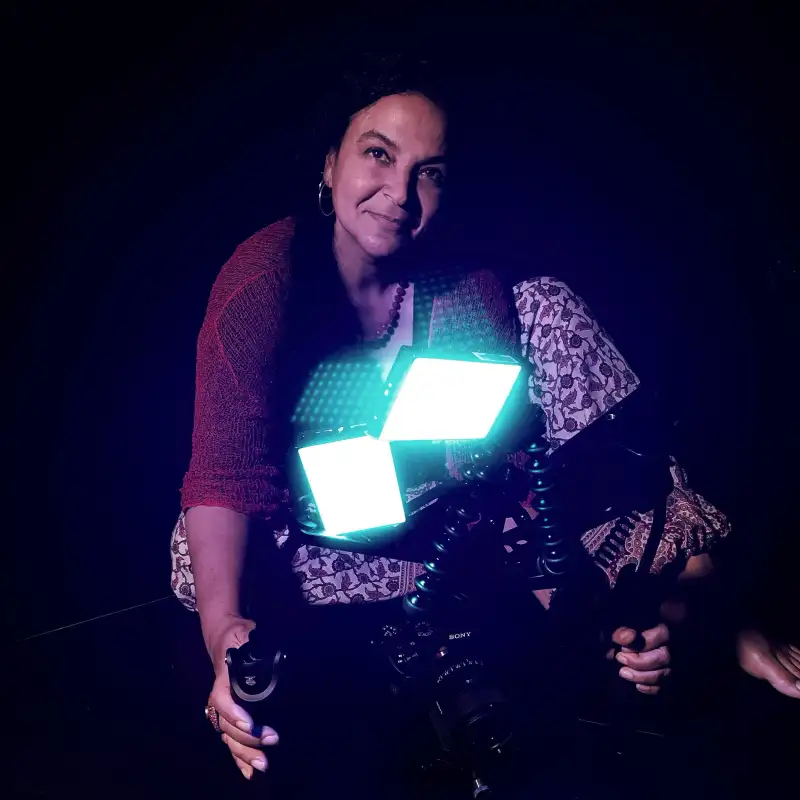
[00:00:00] Gabri Christa: I really literally dance with the camera, um, so I really talk about the embodied camera. I love the moving image, that the moving image moves.That the moving image moves with somebody in it.
[Theme music fades in behind the narration]
[00:00:23] OreOluwa: Welcome to Groovin’ Griot, a podcast about how we use dance to tell stories. I’m OreOluwa Badaki.
[00:00:29] Azsaneé: And I'm Azsaneé Truss. Let's get groovin’.
[Theme music plays at full volume]
[Theme music fades out]
[00:00:49] Azsaneé: On today's episode, we are shaking things up a little bit.
[00:00:52] OreOluwa: As you can probably hear from the background noise. We're not in the recording studio. We're at a different type of studio.
[00:00:58] Azsaneé: Studio 34, to be exact. It's a yoga studio on Baltimore Ave in West Philly that's also a hub for creative performance and social justice movements.
[00:01:07] OreOluwa: I started taking a West African dance class here with Anssumane, who some of you might remember from our seed & sound episode, and I worked on a short film called Bantaba in Baltimore that documented my early experiences…shouting out my co-directors and co-producers, Cristin Stephens and Josslyn Luckett!
[00:01:26] Azsaneé: Hey!
[00:01:26] OreOluwa: *Air horns + Laughter*
Anyway, it was such a great experience working with you all, and it's really cool kind of coming back a decade later to think about, think about that experience.
[00:01:38] Azsaneé: Yeah. Um, we're here because on today's episode we're considering the connections between film and dance and taking a behind the scenes look at what happens when diasporic dance moves between and across streets and stages and sets and screens and so on.
[00:01:52] OreOluwa: Someone who knows a lot about this is Professor Gabri Christa, an Associate Professor of Dance at Barnard College, where she teaches [00:02:00] classes on screen dance and dance in film among other movement based courses. She also founded the Movement Lab at Barnard, which is, quote, “a space for experimentation and exploration at the intersection of movement, performance, and technology.”
[00:02:14] Azsaneé: Professor Christa has unique insights about how dance moves across different media. I'm currently director of the Screening Scholarship Media Festival, or SSMF, and. Ore, you know plenty about that. You have shepherded that festival as well . Um, but as someone who thinks a lot about the role of dance and embodiment within media landscapes, this topic is really interesting to me
[00:02:36] OreOluwa: and it's also part of the origin story of this podcast as it was during the, “What the Body Knows” panel at SSMF a couple years ago that the seeds for Groovin’ Griot were planted.
[00:02:47] Azsaneé: We love a seed.
OreOluwa: We do love a seed.
Azsaneé: There's a lot more we could say about that, but it's kind of chilly. So maybe we should head inside Studio 34.?
OreOluwa: That sounds like a plan.
[00:02:56] OreOluwa:I do love the studio, but every time [00:03:00] I have to hike up these stairs, I question my capacity for whatever class I'm signed up to. Take that day.
Azsaneé: I too am questioning my capacity, but Okay. We finally made it upstairs. Um, we're in the common area of Studio 34.
[00:03:19] OreOluwa: Oh, it's so nice.
Azsaneé: It's… there's lots plants. Even though it's a little gray outside today, there's lots of natural light. It's really beautiful in here.
OreOluwa: warm. It feels welcoming. Um, do you wanna head to the library if it's open? Wanna try?
[00:03:32] Azsaneé: We're in a cozy library right next to the little common area that's here. Let's get to the conversation with Professor Christa. I couldn't make it to New York City for the interview, but Ara, you got the chance to sit down with her?
[00:03:43] OreOluwa: I did, and she started by telling me a bit about her background as a multidisciplinary artist in which, interestingly enough, yoga also played a pretty big role.
[00:03:53] Gabri Christa: So dance, it's a funny story 'cause I came to dance through yoga. Now you see a lot of dance people [00:04:00] teaching yoga.
Um, as a 9-year-old, uh, my dad put me on it. He and I stayed. That's the thing I did. It was very odd. At the time. It was not, yoga wasn't in, um, and through yoga I started making solo dances. Made my own costumes, did a whole thing, had no clue what I was doing. That was before the internet or anything like that. Um, yeah. And so then I had a teacher, not my teacher, but a teacher on Curaçao who saw it 'cause I did an op, I did a performance at the opening of an exposition and. She had seen it and she had come to me. I mean, I chuckle like, what was I thinking? You know, let me do a solo dance for the opening of your exposition.
But I
[00:04:49] OreOluwa: did. Were you still nine or how?
[00:04:51] Gabri Christa: was No, I was 16, but still.
[00:04:52] OreOluwa: Wow. But still, still very young,
[00:04:53] Gabri Christa: but still, still like
[00:04:55] OreOluwa: the confidence of youth.
[00:04:58] Gabri Christa: Or the ignorance or, [00:05:00] I always say, to me, more that I wasn't really busy with what people were thinking. I think it's harder to do that now when you have social media and people taking picture…I just was just doing it.
[00:05:10] OreOluwa: Mm-hmm. '
[00:05:10] Gabri Christa: cause I had something to express. Um, but she saw it. Her name is Dolly Beckers and she came to the airport when I went with my. big bursalen plane, all the scholarship students altogether 400 or something of us went to the Netherlands to study 'cause we're colonies. Mm-hmm. I'm originally from Curaçao , the Dutch Caribbean. Um, my parents are Dutch and from Suriname where all my ancestors are from. Um, and she came to the airport right before takeoff, gave me a piece of paper and she says, you are a modern dancer and you should go to this person in Utrecht where we first landed, and check it out. And I did.
I've naturally always been an artist who [00:06:00] does different things, and so the disciplines are a way of expressing whatever the storytelling is at that moment.
Mm-hmm. Um, I started writing as a young girl and also acting, working in assistant production with also Felix De Roy back on the island, and have been mentored by people such as Felix de Roy, Norman de Palm, that really, um. Multidisciplinary artist, including my yoga mentor, um, Leo Floridas. All black men. Who really just moved in between disciplines. So I grew up seeing that and thinking it was a natural thing to do. I'm a maker. That's how I see myself. Um, I come from dance and yoga, so I approach film and curation even [00:07:00] through an embodied sensibility.
[00:07:05] Azsaneé: So Professor Krista clearly had lots of influences growing up and saw how the artists around her were moving dexterously between disciplines.
Even still, she centered that quote, embodied sensibility that she talked about. This makes me think a lot about, um, the episode that we recorded last season with Professor Deb Thomas. Um, and she talked a bit about how when she enters a space, she kind of leads with an embodied presence, um, which is…a much less, uh, eloquent way of, of summarizing everything that she said in that moment.
But essentially she, um, noticed that, that when she enters a space, the first thing she notices is the bodies and who's moving and how they're moving in that space. And it really translates into her filmmaking practice.
[00:07:47] OreOluwa: Yeah, yeah. And I think it’s really helpful to kind of come back to pull that strand out and focus in on that, cause many of the folks we talk on this podcast are multidisciplinary, are[00:08:00] engaged in so many different art forms
[00:08:01] Azsaneé: Working across mediums.
[00:08:02] OreOluwa: Working across mediums, exactly. And so it's nice to think about the filmic and choreographic in tandem.
[00:08:08] Azsaneé: Yeah, as with Professor Thomas, movement and dance served as an important anchor for Professor Issa's practice. She has since become a pioneer in screendance, a hybrid artistic form that puts cinematography and conversation with choreography. Her latest screendance film, Kankantri, stems from this work.
[00:08:25] Gabri Christa: So I started this research in 2000 when I got a Guggenheim for choreography and I wanted to look at Winti, at the Winti ceremony, which I did, and at, uh, dances from the maroons in Suriname, the runaway. You know, and um, and there's a big population in Suriname who lives deep in the Amazon, quite deep, and who've been independent since like 1700.
It's a really large population still, so you have the different tribes. [00:09:00] Um, so a lot of their culture is preserved. So I visited this, the, some of the villages. I stayed there. I looked at the dances such as Awasa and Seketi, uh, which are actually in the film, a little part of it. Um, the part that I have in the film is from the Aukaans, (N’Djuka) people.
Um, and I got really intrigued by, just the whole country and the different religions that live there. And then with Wint, what was interesting, is interesting to me in all the other syncratic religions, is how they incorporate different aspects besides the African, of maybe the Dutch or the Jewish people, or the Indonesian people, how it keeps evolving. Like the same thing with, with Voodoo, of course. Right? So the iconic images that the people were [00:10:00] like, oh, the French have Catholic. So you see the things that come that are there. Um, so I started to get really interested in that at that time and started learning more about it.
[00:10:11] Gabri Christa: Um, so I made a piece called Yeye and we toured that it was evening length work and I incorporated, you know, elements, elements of it 'cause I'm very clear that I'm really a contemporary maker.
I'm an experimentalist. I'm not trying to replicate on stage what I see, but I get inspired by it. Even though I can really talk about where things come from. And sometimes that confuses people because they think I do more folkloristic, but I don't.
OreOluwa: Hmm. Interesting.
Gabri Christa: Um, I'm really. That, like, I'm from the new, I'm Creole in it's truest sense, like the mixture of the new world, right? Um, that's how I see myself more. So, um, even though I deeply love the [00:11:00] practice of everything I've seen.
What happened when I was there for this research trip. Um, so I went there, came back, made this piece, I went back to perform it, but I, um. I landed in the synagogue and I was very, very emotional in the synagogue.
And a lot of people said, oh yeah, it's sand, and because it has sand. And I said, in Curaçao we have a synagogue with sand. I don't know why. So that led me to really researching, calling my dad and say, “Hey, what is your lineage? Because I know about the African, I know about the Chinese, but. Uh, clearly your father is also mixed, but I don't know anything.”
And he says, “oh, that's all Jewish and Black.”
[00:11:53] OreOluwa: And you didn't know prior to that?
[00:11:54] Gabri Christa: I didn't know.
[00:11:55] OreOluwa: Wow.
[00:11:56] Gabri Christa: Yeah. And so that's when I started this whole [00:12:00] trip. But also when I was there I was like, oh, I need to film in this synagogue. So the idea of Another Building, the series I have that places, Kankantri belongs to that series, um, is, it places dance and film in and around historic buildings related to the Dutch colonial past, including the synagogue.
[00:12:25] OreOluwa: Professor Christa told me that when making films like Kankantri, which unpack the complex histories of structures like the synagogue she encountered during her research trip in Suriname, she often considered how to render for audiences the sort of embodied experiences she has in those spaces.
I remember for the Bantaba on Baltimore project, we had a talkback session with some of the folks who were in the class. We showed a rough cut and talked about what we saw, what we felt, and quite a bit of the conversation was around the complicated history of this space being in West Philadelphia[00:13:00] In a place that has had many migrations
Azsaneé: …Gentrification…
OreOluwa: and impositions of, of folks of, people in this space. Um, and how to, kind of mire through that and navigate that in a way that promotes conscientiousness and criticality.
Really talking about the importance of spiritual practices, the space being open to the spiritual and cultural practices, um, that help people navigate these complicated histories.
[00:13:29] Azsaneé: Mm-hmm.
[00:13:33] OreOluwa: And for Professor Christa. This was also part of her practice, kind of, considering the non-material energies of a space.
[00:13:43] Gabri Christa: ‘Cause I play with the idea of spirit that's present.
[00:13:47] OreOluwa: Yeah.
[00:13:47] Gabri Christa: Um, but not that, this other thing. I believe it is there at the same time. So there's this reality and there's the reality, for me, where I call the horizontal reality that's [00:14:00] also there at the same time.
So in the case of Kankantri, the going in and, and out of horizontal and the reality you see, I made that very fluid through the way I filmed it, but also the way I make that fact, and not something that is debatable. 'Cause that will be something that's there. It's present. The ancestors are present.
Um, what you see as spirit is there. What you feel like going back to when I was in the synagogue, I felt something and I'm trying to visualize what I feel in a way.
[00:14:40] Azsaneé: Alright. Professor Christa has given us a lot to consider. Let's pause here for a little movement break.
[00:14:45] OreOluwa: For this movement break, we'll take you to a salon that was hosted by the Movement Lab, which Professor Christa helped to found. The salon features the work of André Zachary, the Fall [00:15:00] 2025 Artist in Residence at the Movement Lab, and Artistic Director of Renegade Performance Group. The sound collage that we're about to share is from his work Echo Making, which quote, “rooted in Black sonic transmission and memory, explores the Black body as both archive and instrument.
******
[Audio from Movement Break fades in]:
[00:15:20] Speaker 1: *Poem 1*
[00:16:21] Speaker 2: *Poem 2*
[Audio from Movement Break fades out]:
******
[00:17:32] Azsaneé: Welcome back. We hope you can hold onto wherever those echoes took you, as we'll come back to the theme of echoes later this season. But for now, let's get back to Professor Christa's interview.
[00:17:41] OreOluwa: She mentioned at the top of the episode how she approaches her filming practice so I wanted to hear more about what that looks like pragmatically on a set.
[00:17:51] Gabri Christa: When I first started filmmaking, I worked with other people, a lot of men. I. I learned how to, you know, the Hollywood [00:18:00] thing, the shots and how to set up things, how to do the this and the that, and the logline and the treatment and et cetera. And it never felt organic, or didn't feel like I could do it until I worked with, um.
Only once with this DP who also happens to be or, um, having this Dutch colonial background with Indonesian from the Netherlands. And his name is, uh,Leonard Retel Helmrich. Won a Cannes Best Cinematographer award. And he has this orbiting movement with the camera. And I collaborated when he invented a dual gimbal.
I'm getting very geeky now.
OreOluwa: Please do.
Gabri Christa: And um, it was called the Comodo and then the Orbit and all non-electronic, but you could like do a gimbal, hold it. And I choreographed a piece for him [00:19:00] trying out this dual gimbal and I was blown away. 'Cause I saw him moving, going in and out of the action and kind of like dancing with and I was like, oh.
It made so much sense of me, for me, completely changed my whole trajectory as a filmmaker. Um, I started picking up the camera myself. I started thinking, oh yeah, because, you don't have to pick up. So he does a lot of single shot cinema, which I do. And then I started more like expanding sort of through what he's been doing.
I teach that in my screendance class. That's the great thing about teaching. I just teach what I'm learning. It's great.
[00:19:45] OreOluwa: Works out. Yeah.
[00:19:46] Gabri Christa: Works out really well.
[00:19:47] OreOluwa: Everybody wins. Your students win. You win.
[00:19:48] Gabri Christa: They win. I'm excited because I'm like, I developed this course and we're gonna do single shot filmmaking.
I got his. Dual gimbals 'cause I just started, no idea if it was gonna work. I think [00:20:00] it's like the best thing to work 'cause I have a lot of dancers in the class. So I don't start with all the traditional things. I said you can find it on Google and you can get all the lists, but this is learning.
What is your point of view? What do you think? How can you move, how can you film uhhuh? And so I dance with the camera.
[00:20:17] OreOluwa: Yeah.
[00:20:18] Gabri Christa: I really literally dance with the camera, um, , so I really talk about the embodied camera. I love the moving image, that the moving image moves. That the moving image moves with somebody in it. And so you'll see that in my films, the more, yeah,
[00:20:35] OreOluwa: I remember the scene from Kankantri..
[00:20:36] Gabri Christa: Yeah.
[00:20:37] OreOluwa: Many scenes, right? Where you're mo.. is it counterclockwise?
[00:20:39] Gabri Christa: Well, well, Kankantri is the one that I did everything counter…counterclockwise because all the rituals go clockwise.
So you, you have should have seen that too.Like, you know, in Candomble, all the native dancers, they all go counterclockwise.And um, so I said, and I think it helps with how the film feels 'cause I [00:21:00] said, okay, everything has to go counterclockwise. There are few exceptions, but most of the camera moves counterclockwise.
So you get a different feel also of sort of, calling in the spirit. Right? I don't do that in all the films, but definitely work kind of with a single shot idea so that you know where your movement starts of the camera and where it ends. And so then also, and I designed those and I choreograph those, um, even if I don't do the camera.
[00:21:29] Azsaneé: Professor Christa also gave us another example of what the embodied, or dancing camera, could look like. She mentioned the work of Antoine Marc, a creative director, technology producer, and choreographer who is doing innovative work with drones in the screendance space.
[00:21:42] Gabri Christa: And he did very interesting dance film. It took a long time where he really has this drone choreographic moments with the camera and it was like the best I've seen.
[00:21:57] OreOluwa: Wow.
[00:21:57] Gabri Christa: Took a lot because it's almost like the [00:22:00] concept of dancing with the camera, but then dancing with the drone and it wasn't just capturing, 'cause there's a difference between capturing something and the difference in between having a dialogue.
So I see the camera…and the camera person…in dialogue with the body and also an embodied person. So there are two embodied entities and he's playing with that in the drone, how that really works and very interesting.
But it takes a lot and a lot of people. Because you really can't just fly a drone in the face while you're dancing either.
[00:22:44] OreOluwa: No, that sounds very dangerous.
[00:22:45] Gabri Christa: Yeah. Yeah. So it really requires choreographing the drone.
[00:23:07] OreOluwa: Both of the examples of embodied, or dancing, cameras that Professor Christa shared involved innovative use of cutting edge technology. And while working with technology is an important part of Professor Christa’s craft, she's careful not to let the technology overshadow the story. At the end of the day, her practice is about centering and highlighting embodied connections.
[00:23:28] Gabri Christa: Funny enough, I've worked a lot with technology and I still work with technology, I think it's always the last resource.
So if I need it. So I wanna make a film, obviously I work with a camera. Um, I've worked. Earlier work, where I did a piece called Dominata and other pieces, performance pieces, I had video in it, on screens. I was already thinking about, okay, how does that work if I use projections, how does [00:24:00] it…like, what I wanna say and how I can best say it for that particular piece is what determines the technology.
Um, we are in a digital age, which is great. And there's a lot of unconscious just doing things.
[00:24:19] OreOluwa: Mm-hmm.
[00:24:20] Gabri Christa: Just shooting and without really looking at what are you saying and how are you saying, who are you foregrounding, who are you not foregrounding?
So those are like really critical questions I would always ask like, okay. Do you need this? It looks good, but you know? And I asked myself that too.
[00:24:38] OreOluwa: Mm-hmm.
[00:24:38] Gabri Christa: So, yeah,
[00:24:39] OreOluwa: Towards the I asked Professor Christa about other Griots who have informed the questions she asks in her work
[00:24:46] Gabri Christa: I cannot forget to mention a huge influence in my life and dear friend, Maryse Condé . Um, who really gave me my sense of [00:25:00] identity in a way that I was really looking for. First by reading an interview she did. And, uh, then meeting her in Amsterdam. And then we've become friends and I've gotten to go perform in Guadalupe at Pointe-à-Pitre and she came to New York. I mean, we've been great friends.
Um. She was so important in me understanding sort of my place as a Caribbean artist, and which is not one thing, like an African artist is not one thing…which comes with many forms of storytelling and not just traditional. We have Black folks and Caribbean folks that are experimental, right? Counting myself in that one.
So, um, yeah, she's was very outspoken to it. And of course she's a beautiful storyteller. I made two, two [00:26:00] pieces based on her books.
My piece, Matutina was based actually on a play she wrote, “Trois Femmes À Manhattan”/ “Three Women in Manhattan”, and I had a solo piece that I named after a character in one of her books.
[00:26:17] OreOluwa: Mm-hmm.
[00:26:17] Gabri Christa: So it goes kind of far.
[00:26:19] OreOluwa: Mm-hmm. Mm-hmm. And expanding the universes of these stories through the different modalities.
[00:26:24] Gabri Christa: Right, exactly yeah.
[00:26:26] Azsaneé: and as always, we'll close out this episode with what our guest is groovin’ to these days. Professor Christa had some great recommendations.
[00:26:32] Gabri Christa: I, um, I'm going tonight to see Laraaji.
[00:26:37] OreOluwa: Mm-hmm.
[00:26:38] Gabri Christa: Uh, he's doing Ambient Church. Ambient Church is… activates these churches with digital technology and has, um, different artists in there. Laraaji is doing 45 years since he did his work with, uh, Brian Eno.
And he's just one of those people that's both [00:27:00] spiritual, but so, so ambient music, it's so ahead of its time and therefore timeless.
[00:27:06] Gabri Christa: I've been in my Cuba period, so I've started re-listening to. Franco and Rochereau. The Cuban musicians would go to, you know, for Zaire, what was like Belgian Congo. And so you hear in the music, a lot of the Cuban playing, and then they assimilated the sub.
It really falls in line with me being very interested in what happens when people mix together and then they created the soukous. Right? But the soukous is an incredible influence of the Cuban musicians. Right? So that's interesting to me.
[Theme music fades in for credits]
[Music plays]
[Music is lowered behind the credits]
[00:27:49] OreOluwa: This episode of Groovin’ Griot was produced and edited by me, OreOluwa Badaki, and my co-host, Azsaneé Truss. Our theme music is Unrest by ELPHNT and can be found on [00:28:00] directory. audio.
[00:28:01] Azsaneé: Groovin’ Griot is a part of the Network of podcasts supported by the Digital Futures Institute at Teachers College Columbia University.For another great show from the DFI network, check out the Rediscovering Black and Asian Solidarity Podcast. It offers rare conversation about the history of Black and Asian solidarity, current approaches and its future potential.
[00:28:19] OreOluwa: Co-hosts, Dr. Yolanda Sealey-Ruiz and Dr. Judy Yu feature well-known activists and everyday people who aspire to build Black and Asian solidarity and solidarity among other communities through their work and creative projects. We’ll link to it in our shownotes.
[00:28:35] Azsaneé: That's all for now. Thanks for grooving with us.
[Theme Music fades out]
[00:28:39] *BLOOPERS*